
ASUS Gallop vs Tesla Optimus Gen 3: The 2026 Factory Verdict
One was built to build cars. The other was built to pack motherboards. Only one can survive the 20-second cycle time.
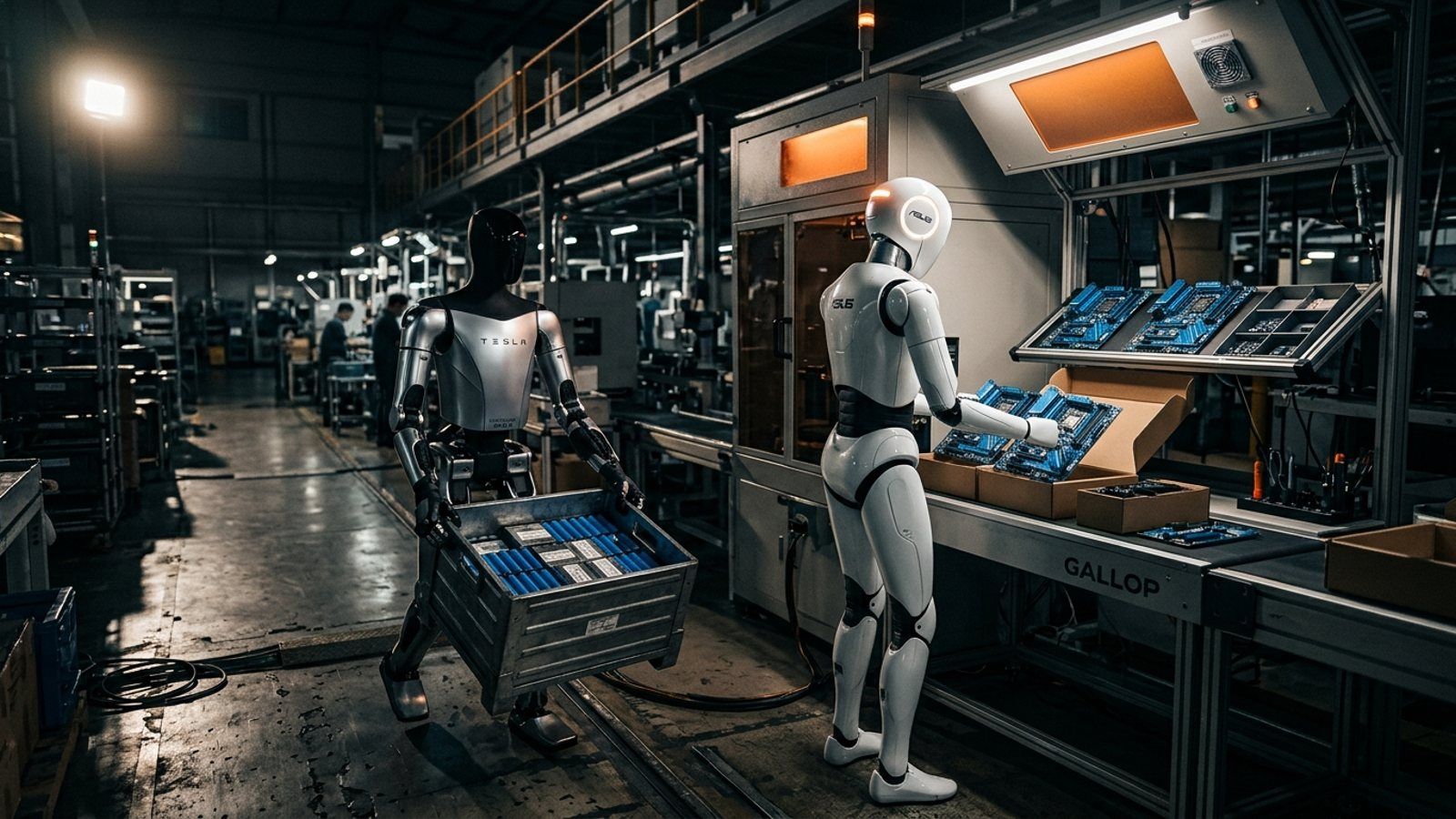
- ASUS Gallop targets a 99.5% success rate packing 15 motherboard accessories in 20 seconds.
- Tesla Optimus Gen 3 features 22-degree-of-freedom hands and a 2.3 kWh battery for 8-hour shifts.
- ASUS uses the NVIDIA Jetson AGX Thor platform, while Tesla vertically integrates its own FSD silicon.
- ASUS Gallop starts customer pilots in 2027; Tesla was producing several hundred units per week by September 2026.
If you need a robot for precise, small-part manipulation like electronics assembly, the ASUS Gallop is the better bet for 2027 pilots. If you need a generalist for moving bins, sorting battery cells, and heavy-duty logistics, the Tesla Optimus Gen 3 has the payload and battery life to win.
I have spent years telling anyone who would listen that the humanoid race wouldn’t be won by the bot that does the best backflip.
It’s about the bot that can survive a Tuesday morning on an assembly line without a supervisor breathing down its neck. On November 13, 2026, ASUS stopped the talk and showed us exactly what that looks like with the Gallop…
ASUS isn’t trying to sell you a robot that folds laundry or makes coffee. They built a machine to do one thing: pack motherboards at an electronics manufacturing services factory.
This is the first time a major PC hardware giant has turned its own manufacturing data into a physical AI product. While everyone else is chasing general-purpose ghosts, ASUS is securing the bag by solving the 20-second cycle time. The focus here is surgical. They aren’t building a butler… they’re building a specialist that never needs a smoke break.
Can ASUS Gallop actually match human packing speeds?
ASUS has set the bar at 99.5% success for packing 15 small motherboard accessories within a 20-second window. That is the exact standard they hold their human workers to in their group factories. It is a brutal metric. Most humanoids we see in demos are moving at half-speed or cherry-picking the easy grabs.
Gallop has to handle thin, clear plastic bags and small, flexible components… things that usually turn computer vision into a mess. If you’ve ever tried to train a model to distinguish between a clear bag and a reflective surface, you know the pain. ASUS isn’t hiding from the glare; they’re training right through it.
Tesla Optimus Gen 3 handles the factory floor differently. Per official specs from November 2026, Optimus is a generalist designed for sorting battery cells and moving items between bins. It has a 20 kg payload capacity per arm, which dwarfs Gallop’s current focus on lightweight electronics.
But in the world of high-speed assembly, weight doesn’t matter as much as precision. If you can’t hit the 20-second mark, you’re just a glorified paperweight on the line. Speed is the only currency that matters on the floor. ASUS knows this better than anyone because they’ve spent decades optimizing the very lines Gallop is now walking.

How does the ASUS Physical AI brain compare to Tesla’s FSD?
Gallop runs on a single NVIDIA Jetson AGX Thor computer. It’s a powerhouse for edge AI, but it’s an off-the-shelf solution compared to Tesla’s vertical stack. Tesla is running its own in-house silicon derived from the Full Self-Driving platform.
Tesla’s advantage is the loop: they have thousands of robots training in their “Optimus Academy” fleet, funneling data back to the Dojo supercomputer. It is an incredible infrastructure play, but the data is often noisy because the environments vary so much. Tesla is trying to solve the world; ASUS is trying to solve the workstation.
ASUS is playing a different game. They are training Gallop by having skilled workers wear head-mounted cameras to record every micro-movement. They then pipe that data into simulation and VR teleoperation to refine the model. It is a Physical AI play that leverages their own production lines as the training ground.
ASUS doesn’t need to simulate a thousand factories; they just need to master their own. By capturing the subtle haptic feedback and visual cues of an expert packer, they’re baking decades of institutional knowledge into the weights of their model. This is the difference between a general education and a masterclass.

Is the ASUS Gallop cheaper than a Tesla Optimus?
Price is the elephant in the room that nobody wants to talk about. Musk has teased a long-term target of $20,000 to $30,000 for Optimus, but as of November 2026, there is no public order page. It’s still internal-use only in Fremont and Texas. ASUS is even more tight-lipped.
They haven’t published a price for Gallop, but the roadmap is clear: customer pilots in 2027 and market availability by 2H 2028. We are looking at a classic wait-and-see scenario, but the first one to ship a commercial unit with a fixed price wins the trust of the CFO.

If you’re a factory manager, you aren’t just looking at the sticker price. You’re looking at the cost of AI coding agents and the infrastructure needed to keep these things running. ASUS is designing Gallop with a modular architecture, meaning you can swap the AI model without rebuilding the hardware.
That is a massive hedge against obsolescence that might give them the edge over Tesla’s more integrated, proprietary hardware. You want to be able to upgrade the brain without having to scrap the body every two years. Modular is the only way to scale in a world where silicon moves faster than metal.
| Feature | ASUS Gallop | Tesla Optimus Gen 3 |
|---|---|---|
| Primary Task | Electronics Packing | General Logistics/Cell Sorting |
| Target Success | 99.5% (Internal Goal) | Not Disclosed |
| Cycle Time | 20 Seconds (15 parts) | Variable |
| Hand Dexterity | Sense of Touch (In-house) | 22-DOF (50 Actuators) |
| Onboard Brain | NVIDIA Jetson AGX Thor | Tesla In-house (AI5) |
| Payload | Light (Electronics) | 20 kg per arm |
| Battery Life | Shift-targeted | 8 Hours (2.3 kWh) |
| Where it loses | Fixed-base/Limited mobility | High proprietary friction |
Which robot is closer to real deployment?
Tesla is currently winning the production race. They’ve already converted the Model S/X lines in Fremont to build robots. Reports from September 2026 state that Tesla was producing several hundred units per week at the Fremont facility. That is a massive lead in manufacturing autonomous AI agents at scale.
Tesla’s bots are already sorting cells in their own battery plants, which is the best proof of work you can ask for. They are building the machine that builds the machine, and that scale is hard to bet against. If they can solve the reliability issue, the sheer volume of units will drown out the specialists.
ASUS is the underdog here, but they have the home-court advantage. They own the factories where motherboards are made. They don’t have to convince a third-party partner to let a prototype onto the floor; they just wheel it in. Gallop is already working at an ASUS group EMS plant.
They are proving it at home first, which is the only way to build a tool that actually works in the production AI stack. Real-world testing in your own environment is the ultimate alpha. You find the edge cases that a simulation could never dream of, and you fix them before the customer ever sees the bill.
I’ve seen enough “hero videos” of robots dancing to last a lifetime. ASUS skipping the demo and going straight to the packing station is the move. Tesla is building the future of labor; ASUS is building a better worker for the factory they already own. If you’re in the electronics business, Gallop is the specialist you’ve been waiting for.
For everyone else, Optimus is still the generalist to beat… but generalists often struggle when the tolerances get tight. The next eighteen months will determine if we want one robot that does everything okay, or ten robots that do one thing perfectly.
Stop waiting for the perfect robot. Start looking at the one that can actually handle your parts.
#TheAIMogul
Bottom lineASUS Gallop is the superior specialist for precision electronics assembly because it was trained on the data of the company that literally owns the workstation. Tesla Optimus Gen 3 remains the king of general-purpose heavy lifting and mobile logistics, but it lacks the station-specific 'muscle memory' that ASUS is baking into Gallop for the assembly line.