
What Is Physical AI? The World Model Era, Explained
Chatbots were the warm-up. Physical AI is the main event: models that don't just talk, but walk, grab, and reason through the physical world.
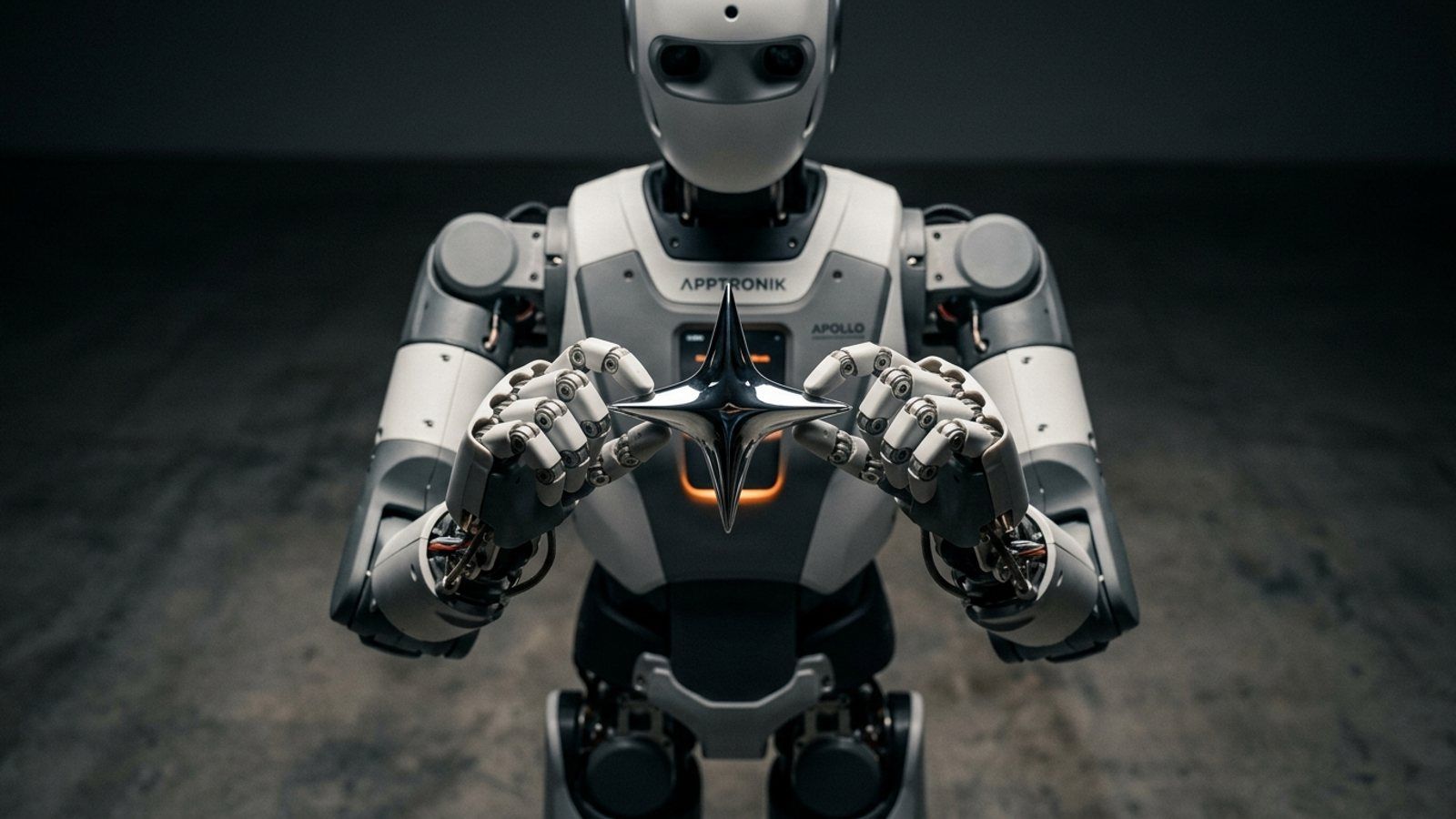
- Physical AI shifts from 'text-in, text-out' to 'vision-in, action-out' using VLA (Vision-Language-Action) models.
- Google DeepMind's Gemini Robotics 2 (released July 30, 2026) established a new standard for whole-body humanoid control.
- The tech moves past pre-programmed loops to 'embodied reasoning,' where a robot can self-correct when it drops an object.
- Gemini Robotics ER 2 was made available in Google AI Studio for developers on July 30, 2026, for building agentic workflows.
Physical AI is a branch of artificial intelligence that focuses on 'embodied' models—systems that can perceive, reason about, and act within the physical world. Unlike Large Language Models (LLMs) that predict the next word, Physical AI uses Vision-Language-Action (VLA) models to predict the next physical movement. Google DeepMind's July 30, 2026, release of Gemini Robotics 2 proved this isn't sci-fi; it's a production-ready stack for humanoids like Apptronik's Apollo 2 to perform complex, multi-step tasks in unmapped environments.
I keep saying this: the era of the ‘clever chatbot’ is hitting a ceiling. If you’re still impressed that an AI can write a Python script or summarize a PDF, you’re looking at the rearview mirror. The real money and the real engineering are moving into the physical world.
On July 30, 2026, Google DeepMind dropped Gemini Robotics 2, and it changed the math for everyone in the AI agent space. This isn’t just a bigger LLM. It’s the first time we’ve seen a ‘World Model’ that actually understands how to move a 160-pound humanoid robot from toe to fingertip.
What is Physical AI and why does it matter?
Physical AI is the transition from ‘AI that talks’ to ‘AI that does.’ For years, robots like those in car factories were essentially puppets. They followed a rigid, pre-programmed path.
If you moved a car door three inches to the left, the robot would keep welding the empty air. This paradigm shift leverages massive datasets of physical interactions to bridge the gap between digital reasoning and mechanical execution.
Physical AI fixes this by using a VLA (Vision-Language-Action) architecture. Per the DeepMind announcement, these models don’t just process text; they ingest live video and spatial data to predict the next physical movement.
It’s the difference between reading a manual on how to ride a bike and actually feeling the balance in your legs. This VLA framework represents a departure from traditional robotics by integrating perception and action into a single transformer-based backbone.
Instead of separate modules for vision and motor control, the model processes visual tokens and outputs action tokens within an integrated transformer architecture, as described in the DeepMind announcement. This allows the system to maintain a continuous understanding of its environment, reacting to dynamic changes with low-latency performance optimized for real-time interaction, according to the DeepMind announcement.
When you tell a robot powered by this tech to “clean up the breakroom,” it doesn’t need a map. It sees a soda can, recognizes it’s trash, understands the physics of how to grip aluminum without crushing it, and navigates around a chair someone left in the way.
The Gemini Robotics 2 Stack
Google didn’t just ship one model; they shipped an entire infrastructure for the physical world. According to MarkTechPost, the release includes three distinct tiers:

One: Gemini Robotics 2 VLA. This is the flagship. It’s the model that handles end-to-end control. It translates a natural language command directly into motor torques. I’m talking whole-body coordination, from walking to five-finger dexterity.

The Gemini Robotics 2 VLA model is built on a transformer architecture that treats sensorimotor trajectories as a language, allowing it to generalize across different tasks and environments. According to the DeepMind announcement, this approach enables the model to perform complex reasoning, such as identifying a ‘fragile’ object and adjusting its grip force accordingly.
Two: Gemini Robotics ER 2. ‘ER’ stands for Embodied Reasoning. This is the brain. It handles the high-level planning for tasks that take hundreds of steps. If the robot drops a tool, ER 2 is what tells it to stop, look down, and pick it back up.
Per MLQ.ai, this model was made available in Google AI Studio for developers on July 30, 2026. This reasoning layer can decompose complex instructions like “set the table for four” into a sequence of sub-tasks, accounting for the location of plates and silverware while managing the physical constraints of the furniture.
Three: Gemini Robotics On-Device 2. This is the edge play. It’s a smaller, high-efficiency model designed to run on the robot’s local hardware. The SRE in me loves this—you can’t have a robot freeze in place just because the Wi-Fi dropped while it was holding a heavy box.
Furthermore, the multi-robot collaboration tier is particularly significant for warehouse automation, where Gemini Robotics 2 can orchestrate a fleet of robots to complete a single, large-scale objective without manual intervention.
Real World Receipts: The Apptronik Apollo 2
We aren’t just looking at lab videos anymore. DeepMind demonstrated this tech on the Apptronik Apollo 2, a humanoid robot being tested at a massive data facility in Austin called ‘Robot Park.’ The Apollo 2 humanoid, standing at 5 feet 8 inches, is specifically engineered to operate alongside humans.
Its integration with the Gemini stack allows it to utilize its force-sensing actuators to interact safely with delicate objects.
In one demo, Apollo 2 was asked to “put the watering can into the green bin on the bottom shelf.” This sounds simple, but it’s a nightmare for traditional robotics. The robot had to walk to a table, identify the can, calculate the grip, walk to a shelf, crouch (whole-body balance), and place it precisely. It did it autonomously.
At the ‘Robot Park’ facility, researchers are documenting how the model handles ‘out-of-distribution’ scenarios, such as unexpected human interference or lighting changes, to ensure the system remains robust in real-world industrial settings. This hardware, designed for high-frequency industrial tasks, features a modular architecture that allows for rapid deployment in logistics environments.
This is why the hardware war is heating up. While we’ve tracked the Figure 03 vs. Tesla Optimus race, Google DeepMind provided the ‘Android’ of robotics software on July 30, 2026, that could potentially power any of them.
The Shift to World Models
The secret sauce here is the ‘World Model.’ Unlike GPT-4 or Claude, which are trained on the internet’s text, Physical AI models are increasingly trained on ‘Video-to-Action’ datasets.
They are learning the laws of physics by watching millions of hours of robot and human movement. World Models are essentially the ‘physics engines’ of the AI mind. By training on diverse video data, the AI learns to predict how the world will change in response to its actions.
This creates a system that can ‘hallucinate’ a solution to a physical problem. If a robot’s path is blocked by a new obstacle, the World Model simulates a few different ways to walk around it before the robot even moves.
It’s zero-shot learning for the real world. This allows for ‘mental rehearsal,’ where the robot can evaluate the success probability of a movement before executing it, significantly reducing the risk of collisions or task failure in dynamic environments.
By predicting the visual and haptic consequences of an action before it is taken, these models reduce the ‘reality gap’ that has long plagued robotics. This predictive capability is rooted in the transformer’s ability to treat physical actions as tokens, much like words in a sentence, allowing for a unified representation of the environment.
If you’re a builder, the message is clear. The ‘Physical AI Hack’ happening in San Francisco on November 28, 2026, isn’t just another weekend project. It’s a call to arms for engineers who want to build on top of Gemini and Nvidia’s spatial intelligence stacks.
It’s time to get your hands dirty…
#TheAIMogul
Bottom linePhysical AI is the end of the 'dumb robot' era. If you're still thinking in terms of chatbots, you're missing the shift to models that actually interact with your physical reality.