
Agility Digit vs Boston Dynamics Stretch Gen 2: The $AGLT Verdict
One humanoid generalist. One box-moving specialist. Two launches in 72 hours. Here is the real-world math on which robot earns its floor space.
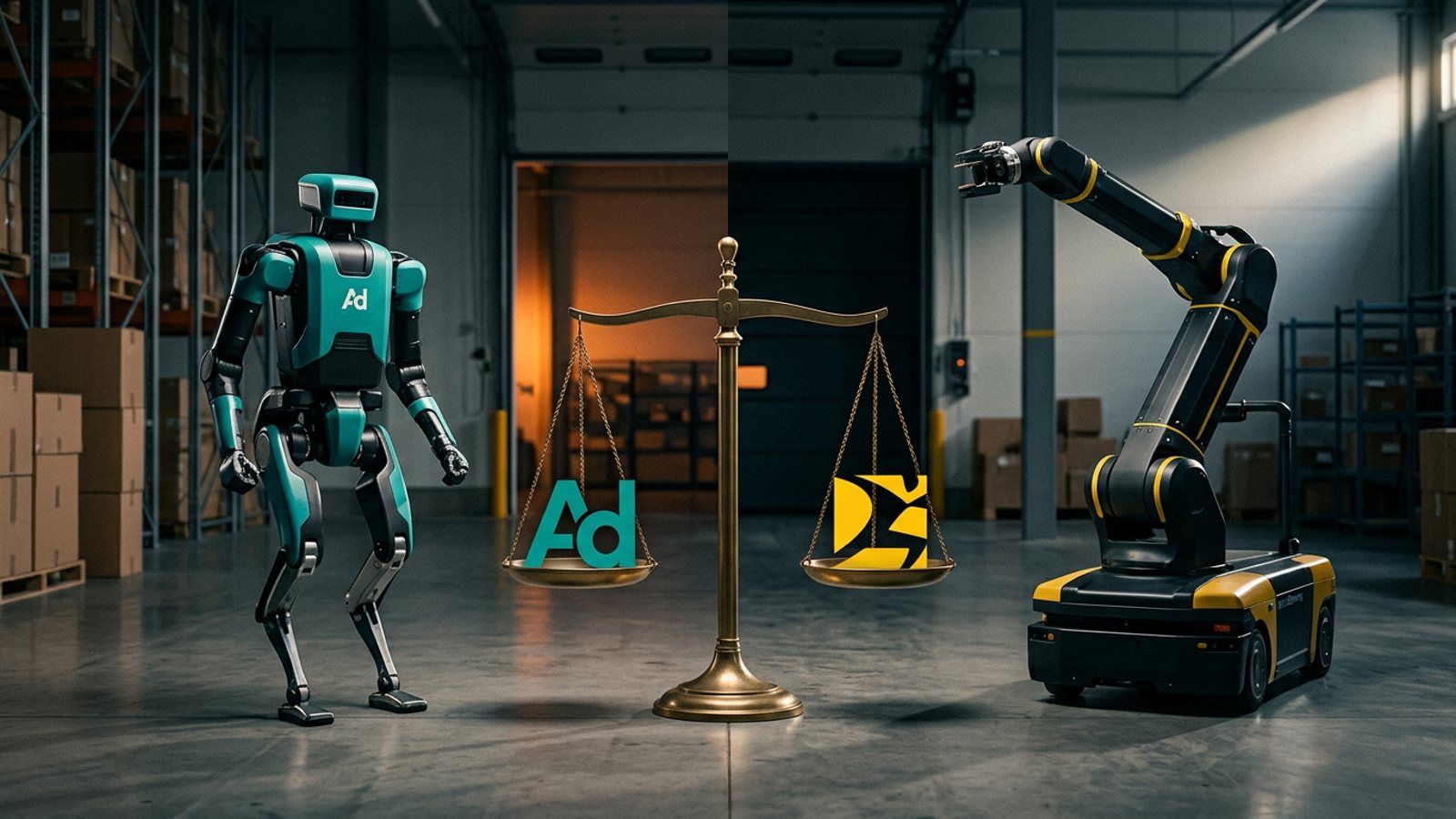
- Agility Robotics (AGLT) went public on Nov 5, 2026, marking a major milestone for the humanoid robotics sector.
- Boston Dynamics launched Stretch Gen 2 on Nov 3, 2026, targeting 1,000 cases per hour in trailer unloading.
- Digit now carries 50 lbs and works 20 hours a day with a 9-minute fast-charge cycle.
- Stretch Gen 2 cut internal cabling by 81% and modularized maintenance for 1-hour part swaps.
- The Verdict: Stretch owns the dock throughput; Digit wins the floor on multi-tasking flexibility.
The choice depends on your specific bottleneck: Boston Dynamics Stretch Gen 2 is a high-throughput specialist that unloads up to 1,000 cases per hour, while Agility's Digit is a versatile humanoid generalist that carries 50 lbs across varied tasks. Stretch is built for the dock; Digit is built for the entire facility floor.
The week of November 2, 2026, was the ‘coming out’ party for robots that actually work. No more CGI. No more remote-controlled demos. Just cold, hard steel moving boxes on a budget.
Agility Robotics hit the Nasdaq on November 5 under the ticker AGLT, reporting 65,000 hours of real-world operation according to their official IPO filing. Two days earlier, Boston Dynamics dropped Stretch Gen 2, a machine built to do one thing… empty trailers until the metal gets hot.
I keep saying this: stop looking for the ‘best’ robot. Look for the best ROI. In the warehouse, that means picking between a generalist that walks like you and a specialist that unloads like a beast.
Agility’s Digit is now the generalist to beat, but Boston Dynamics just raised the floor for what a specialized unloader should do. This is the warehouse war for the soul of physical AI.
Is Digit the first humanoid worth the $8,500 monthly check?
Agility isn’t hiding their math anymore. Their SEC filings reveal Digit costs roughly $8,500 a month on a Robots-as-a-Service (RaaS) contract. For that price, you’re getting a machine that can finally lift 50 pounds repetitively per their official product specifications. That payload bump is the ‘adult’ milestone… it moves Digit from ‘tote recycler’ to ‘material handler.’
But the real ops alpha is the battery. Digit runs for 90 minutes but charges in just 9 minutes. That 10:1 run-to-charge ratio means this thing is on the floor for 20+ hours a day. In my world, that is the difference between a toy and a tool.
You don’t need a fleet of 50 bots if 5 of them never stop moving. Agility has already logged 100,000 totes moved at GXO facilities, proving they can handle the grind without catching cases of mechanical fatigue.
How does Stretch Gen 2 reach 1,000 cases per hour?
While Agility builds a jack-of-all-trades, Boston Dynamics built a sniper. Stretch Gen 2 is a mobile base with a massive arm designed for the dock.
On November 3, 2026, the company announced this new generation can hit 1,000 cases per hour. For context, that is nearly double what a human team usually sustains over a long shift without getting gassed.
Stretch Gen 2 isn’t just faster… it is more durable. They analyzed 100,000 operating hours and found that vibration was killing the electronics. Their fix? They ripped out 81% of the internal cabling… about half a mile of wiring… and replaced it with automotive-grade connectors.
As an old SRE, that’s the stat I care about. Fewer wires means fewer intermittent faults. If a swerve drive does fail, they claim you can swap the whole module in an hour instead of a day. That is how you secure a bag in logistics.
Generalist vs Specialist: Which bot wins the floor?
This is the core decision for any facility manager. Digit can walk up stairs, navigate around a spilled pallet, and switch from moving totes to unloading a conveyor. It is a mobility platform.
Stretch Gen 2, meanwhile, is a throughput monster. It doesn’t walk; it rolls on a pallet-sized omnidirectional base. It won’t help you clean up the breakroom, but it will clear a trailer faster than anything else on the market.
| Feature | Agility Digit | BD Stretch Gen 2 |
|---|---|---|
| Form Factor | Bipedal Humanoid | Mobile Arm (Specialist) |
| Payload | 50 lbs (22.7 kg) | ~50 lbs (23 kg) |
| Throughput | Multi-tasking (Variable) | 1,000 Cases/Hour (Peak) |
| Uptime | 20+ hrs/day (9-min charge) | 16 hrs (2-shift battery) |
| Maintenance | Swappable grippers | 1-hour swerve drive swap |
| Where it loses | Complex dock throughput | Limited to flat floors/docks |
If you’re running a 3PL and your main pain is turnover on the loading dock, Stretch is the play. It is built to be a ‘plug and play’ box-mover that works in dark trailers with zero programming. But if you’re looking at robotaxi-style economics where you need high utilization across ten different small tasks, Digit is the one.
The AGLT IPO performance shows the market is finally waking up to the fact that physical labor is the next frontier for automation. That tells you everything you need to know about the appetite for real robots.
The maintenance reality: 81% less wiring is a big deal
We need to talk about the ‘half-mile’ of wire Boston Dynamics removed. In robotics, every inch of cable is a point of failure. By moving to modular joints and automotive connectors, they’ve acknowledged that the ‘lab’ era is over.
The ‘factory’ era is here. Agility is following a similar path with Digit, using a safety architecture that lets it work without cages.
This is the shift from ‘cool’ to ‘reliable.’ Digit is already deployed at multiple customer sites, proving these aren’t pilots anymore; they are production deployments.
If you’re building a production AI stack, the physical layer is finally catching up to the software. You don’t buy these bots to save the world… you buy them because they don’t call in sick on Monday morning.
Logistics isn’t a playground… it is a game of uptime and cents per movement. Agility Digit is the first humanoid that doesn’t feel like a science project. It is a utility player you can put on the roster today. Meanwhile, Stretch Gen 2 is the heavy hitter you bring in for the most grueling part of the shift.
If you are still waiting for a robot that can do everything, you are missing the machines that are already doing something. Stop chasing the perfect humanoid and start solving the specific bottleneck… efficiency is the only metric that survives the quarterly review.
The industry is moving from ‘if’ to ‘how many.’ We are seeing the death of the prototype. When a company lists on the Nasdaq with 65,000 hours of receipts, the debate is over. You either automate the dull, dirty, and dangerous work, or you get outscaled by the shops that do.
The choice between a 50-pound payload humanoid and a 1,000-case-per-hour specialist is a high-class problem to have. It is time to stop watching the videos and start reading the spec sheets.
Pick the specialist for the pain point. Pick the humanoid for the platform.
#TheAIMogul
Bottom lineIf your bottleneck is unloading trailers, buy Stretch Gen 2. Its 1,000-case-per-hour throughput is a specialist benchmark that no humanoid can touch today. But if you need a robot that can move totes between conveyors, walk to the recycling bin, and adapt to three different workflows in a single shift, Digit is the only commercially proven answer. The Agility IPO proves that the market finally values 'real work' hours over viral backflip videos.