
Flora Verdict: Why NVIDIA’s 125x Efficiency Play Changes Robotics
NVIDIA's new open-weight suite isn't a robot brain... it's the industrial engine that builds them for 1/125th the cost of the frontier.
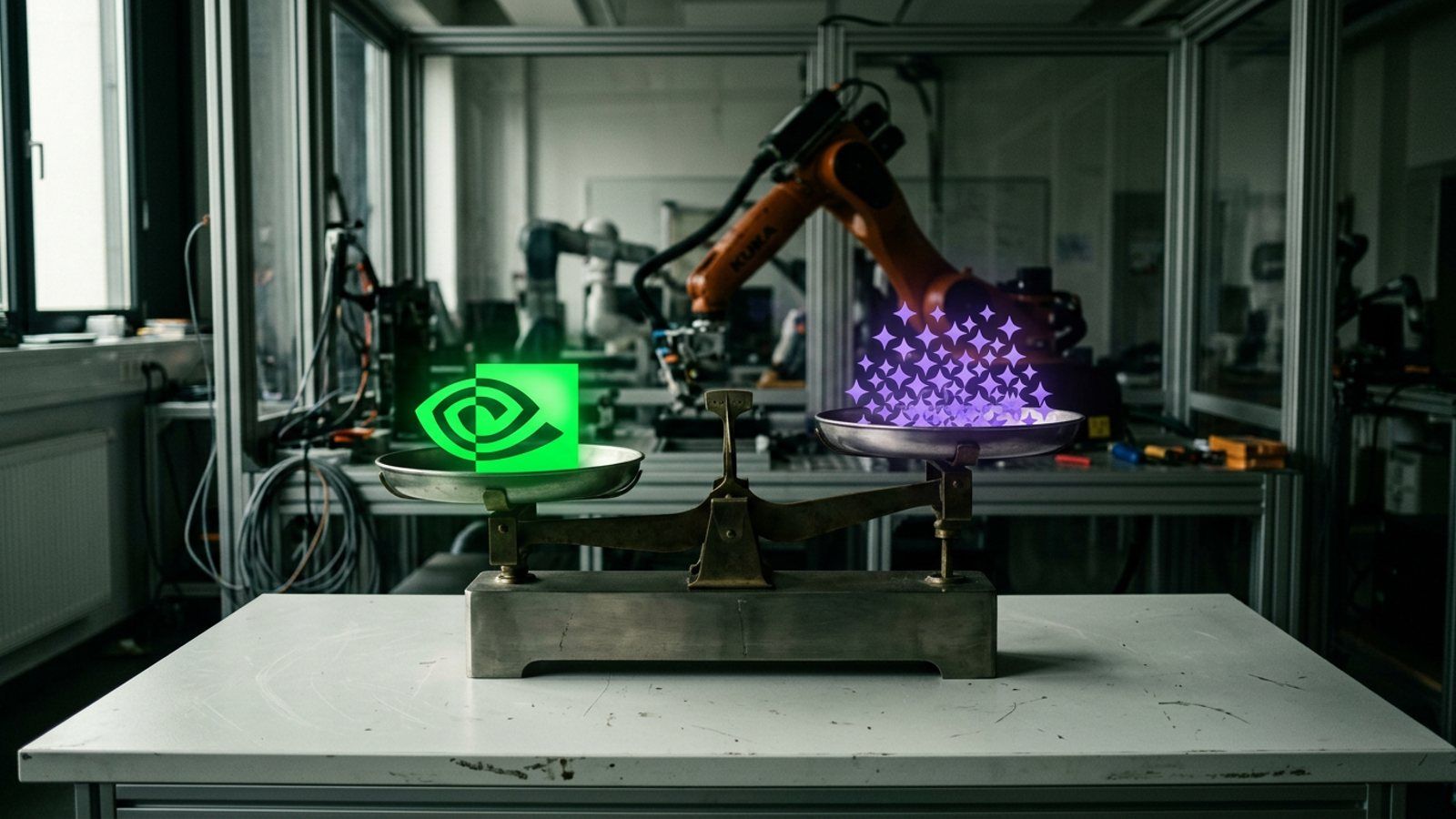
- NVIDIA released the Flora model suite on October 20, 2026, designed to automate robotics data labeling.
- The system is roughly 125x cheaper than using GPT-6 Astra for the same annotation tasks.
- Flora includes three specialized models (9B and 27B) post-trained on Qwen 3.5 for segmentation, captioning, and rewards.
- It is currently restricted to non-commercial research use under NVIDIA's OneWay license.
NVIDIA Flora is a suite of three open-weight AI models—a segmenter, a captioner, and a rewarder—released on October 20, 2026. It is designed to turn raw video of humans or robots into high-quality training data for robotics foundation models. By automating the labeling process for 125x less than the cost of GPT-6 Astra, Flora allows researchers to scale their training datasets without the massive API bills typically associated with frontier models.
Stop looking at the metal and start looking at the math. In the world of physical AI, the bottleneck isn’t the motors or the sensors… it’s the data.
We’ve been stuck in a loop where training a robot to pick up a cup required either thousands of hours of expensive human teleoperation or burning millions in API credits to have a frontier model like GPT-6 Astra label the video. NVIDIA just broke that loop.
On October 20, 2026, Jim Fan and the GEAR team at NVIDIA released Flora, an industrial-strength data engine suite. It is not a single model. It is a three-headed beast designed to automate the messy, expensive work of turning raw video into the tokens a robot can actually learn from.
The headline number isn’t a benchmark score… it’s the fact that Flora does this work for roughly 125x less money than GPT-6 Astra.
I’ve been saying for a year that the best AI agents are the ones that do the boring work at scale. Flora is the ultimate proof. It doesn’t write poetry; it labels 200,000 hours of robotics video a day across NVIDIA’s internal clusters. That is the kind of SRE-level scale that actually moves the needle on humanoid robot development.
Is Flora a robot controller or a data tool?
Terminology matters. Flora is not the brain that moves the robot’s arm in real-time. It is the teacher. NVIDIA released three specific models on Hugging Face: a 9B Segmenter, a 27B Captioner, and a 27B Rewarder. All three are post-trained on Qwen 3.5, according to the official model cards.
The Segmenter looks at a long video and chops it into meaningful sub-tasks, like “reaches for cup” or “grasps handle.” The Captioner writes the text instructions for those segments so the robot understands the intent.
The Rewarder provides the grade, telling the training loop if the robot actually succeeded or just flailed its fingers. This is the exact pipeline NVIDIA used to train its GR00T-2 models, and now they’ve handed the keys to the research community.
But there is a catch y’all need to peep. This isn’t an Apache 2.0 free-for-all. NVIDIA released these under their OneWay Noncommercial License. If you’re a startup trying to build a commercial product, you can look but you can’t touch.
At least not for production. It’s a classic NVIDIA move: dominate the research layer to ensure everyone is building on their stack, then keep the commercial gates tight.
How does Flora compare to GPT-6 Astra?
If you’re wondering why you shouldn’t just keep using the frontier APIs, the answer is the bill. NVIDIA’s internal testing shows that while GPT-6 Astra is a beast at reasoning, it is an absolute budget-killer for industrial data labeling.
In their “Astranomy” report, they noted that an agentic policy using Astra can cost over $36 per episode compared to the pennies you spend running Flora locally.
Flora isn’t just cheaper; it’s competitive. On benchmarks like WGO-Bench (for captioning) and RoboReward, Flora scores at SOTA levels.
It’s essentially matching the quality of the world’s most expensive models while running on a fraction of the compute. For a research lab with a rack of GB300s, this is the difference between training for a week or training for a year.
Flora is labeling 200,000 hours of data daily using 512 GB300 GPUs. That is a level of throughput no API-based workflow can touch without a nine-figure credit line. It makes the $20/month you pay for Perplexity Pro look like pocket change compared to the industrial capital being deployed here.
Where does Flora lose?
It isn’t all sunshine and open weights. The biggest loss is the licensing friction. By locking this behind a non-commercial license, NVIDIA is effectively tethering the most advanced robotics data pipeline to their own ecosystem.
You can innovate in the lab, but the minute you want to secure a bag, you’re going to have to negotiate a different deal or rebuild from scratch.
Second, it’s a high-floor tool. This isn’t for the hobbyist with a single 3060 GPU. To run the 27B Rewarder or Captioner models effectively at the scale they are intended for, you need real enterprise iron.
It’s a tool built by SREs for SREs. If you don’t have a data pipeline to plug this into, it’s just another set of weights sitting on your drive.
Finally, it’s a specialist, not a generalist. Don’t try to use Flora to plan a vacation or write code. It is laser-focused on physical manipulation and video-to-action reasoning. It’s the ultimate employee for a very specific job: grading robot homework.
| Feature | NVIDIA Flora | GPT-6 Astra |
|---|---|---|
| Primary Use | Robotics Data Engine | General Reasoning/Policy |
| Cost | 125x Lower | High API Fees |
| Access | Open Weights (Hugging Face) | Closed API |
| License | Non-Commercial | Proprietary |
| Where it loses | Restricted to Research | High Latency & Cost |
NVIDIA just handed the industry a massive W, but they kept the leash short. If you’re in a research lab, stop the theories and start downloading. For everyone else, keep an eye on the startups that are inevitably going to try and replicate this performance on a truly open license.
Scaling is the only way forward…
#TheAIMogul
Bottom lineFlora is the plumbing the robotics industry desperately needed. While everyone else is chasing the "God Model" to control a single hand, NVIDIA just gave researchers the industrial-scale factory to train a million hands. It’s not a controller; it’s the teacher's aide that scales to 200,000 hours of video a day. If you’re building in physical AI, this is your new baseline for data ops.