
Monumental vs Hadrian X: The Robot Bricklayer Verdict
Monumental just finished a full house in Almere with zero human hands on the bricks. Here is why the 'Subcontractor' model is beating the 'Giant Truck' model in 2026.
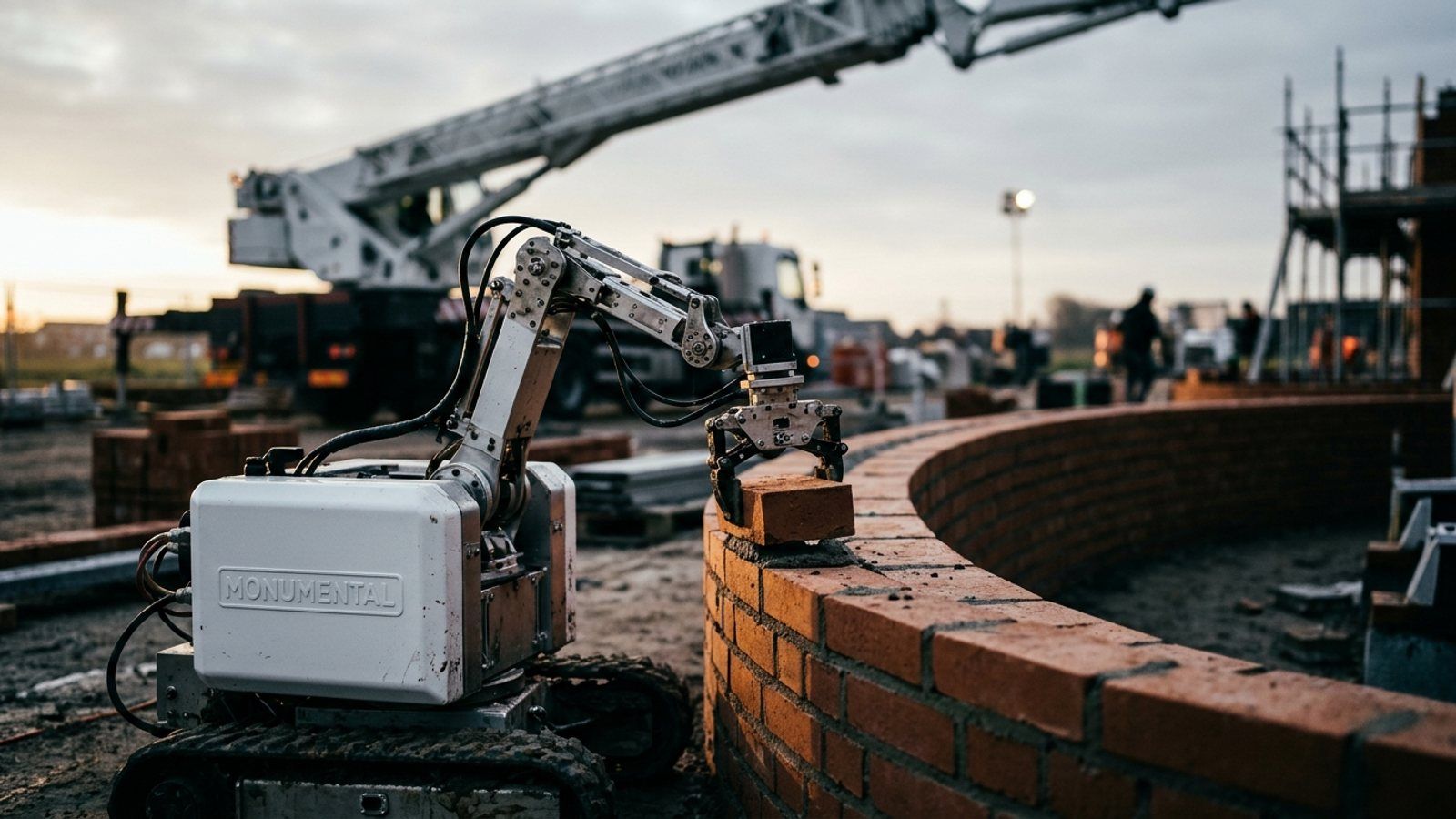
- Monumental uses a 3-robot squad (Pisa, Petra, Panama) to lay walls with millimeter precision and curved aesthetics.
- Hadrian X (FBR) is a 32-meter truck-mounted monster that lays 360 large-format blocks per hour.
- The business model is the winner: Monumental sells 'completed walls' as a subcontractor, avoiding the high sticker price of rivals.
- Monumental has built 100+ homes and just completed its first 100% robot-laid house in Almere.
Monumental wins for most residential builders because it operates as a subcontractor. You pay per brick or per square meter, exactly like a human crew, but the robots never get tired or complain about the heat. While Hadrian X is faster on straight production walls, Monumental's agility on messy, real-world sites and its lower barrier to entry make it the more durable solution for the housing shortage.
Listen… everyone is obsessed with the “brain” of the bot, but the real money in 2026 is moving into the “hands.” We have a massive housing shortage in the US, and the masonry workforce is aging out faster than we can replace it.
You can’t code your way out of a housing crisis with another chatbot. You need bricks in the ground. Stop waiting for the “perfect” humanoid to arrive. It’s costing you millions in unbuilt inventory.
I have been watching the tape on Monumental for a year. They just completed a house in Almere, Netherlands, where their robots placed 100% of the bricks Dealroom, October 28, 2026.
No “prototypes,” no “demoware.” They are building neighborhoods while everyone else is still rendering them. This isn’t a lab experiment… it is a construction site. The Dutch are proving that the future of labor isn’t about mimicking humans; it is about outworking them with specialized machines that don’t need a lunch break.
But the real war is not just about who can lay a brick… it’s about how you buy the work. On one side, you have the Australian giant Hadrian X, a truck-mounted monster that builds a house in a day. On the other, you have Monumental’s squad of agile electric rovers.
One is a machine; the other is a service. It is the classic debate of capital expenditure versus operational efficiency. In a high-interest rate environment, the winner is usually the one who doesn’t blow up your balance sheet before the foundation is even poured.
Is Monumental better than traditional human crews?
Monumental wins because it doesn’t ask you to change your workflow. They turn up to the site as a subcontractor Construction Briefing, July 16, 2026.
You pay them per brick or per square meter, exactly like you’d pay a human gang. If the robot breaks, it’s their problem, not yours. This is the “System 0” approach I keep talking about… hide the tech, sell the result. No one cares about the LIDAR sensors when the wall is straight and the invoice is clear.
The hardware is a three-robot tag team: Petra (the supplier), Panama (the mortar guy), and Pisa (the layer) Monumental, 2026. They are small enough to fit through doors and navigate messy, uneven sites that would choke a larger machine.

Most importantly, they handle the “ugly” stuff: curved walls, indented text, and soldier courses. If you are building a boutique hotel or a curved residential facade, a traditional robot is a paperweight. Monumental is a craftsman that actually understands the aesthetics of modern architecture.
Human crews are increasingly hard to find, and when you do find them, the quality is a coin toss. Monumental’s fleet brings a level of consistency that humans simply cannot match over an eight-hour shift in the rain.
They don’t get tired, they don’t get distracted by their phones, and they don’t make mistakes on complex bond patterns. For a developer, this means fewer change orders and less time spent on site inspections. You aren’t just buying speed… you are buying the peace of mind that comes with precision engineering.
How does Hadrian X compare on speed and scale?
If Monumental is the sniper, Hadrian X is the heavy artillery. This thing is a 32-meter telescoping boom mounted on a truck FBR, 2026.
It doesn’t use standard bricks; it uses large-format blocks that are twice the size of what a human can comfortably lift. It can lay 360 of these blocks an hour. This is raw, unadulterated power designed for the suburbs of the future where speed is the only metric that matters.
In a raw speed test, Hadrian X is the king. It can wall a standard house in about 24 hours. But there is a massive catch: the “Hadrian Tax.” You need their specific blocks. You need their proprietary adhesive. And if you want to own one, be prepared to cut a check for roughly $7.8 million AUD FBR, 2026.
That is a lot of bricks before you see a return on investment (ROI). Most developers aren’t in the business of owning multi-million dollar assets that require a specialized team of technicians just to start the engine.
Hadrian X is a marvel of engineering, but it’s a specialist tool for massive, repetitive block work. It thrives in open spaces where the 32-meter boom has room to breathe. The moment you move into a dense urban environment with overhead power lines, narrow alleys, and tight setbacks, the Hadrian X starts to look like a liability.
It is the Range Rover of construction… impressive on the highway, but a nightmare to park in the city. If your project isn’t a massive greenfield development, the overhead of the Hadrian X might outweigh its speed advantages.
Which robot bricklayer should you hire for your project?
It comes down to your blueprint. If you are building 200 identical square boxes in a desert, you call FBR for a Hadrian X. It is a production line on wheels.
But for the 99% of us building in real cities with tight lots and architects who like curves, Monumental is the alpha. They fit into the world as it exists today, not some idealized version of a construction site where everything is flat and perfectly staged for a robot.
I ran the numbers on their latest funding… they just secured a $32 million Series B led by Khosla Ventures Ottomate, July 31, 2026. That money isn’t for R&D; it’s for the US launch. They have already built 100+ homes across Europe.
They are proving that physical AI agents don’t need to look like humanoids to take the bag. They just need to show up and GSD. This capital injection is a signal that the market is ready for a scalable, low-friction entry into robotic construction.
| Feature | Monumental (The Squad) | Hadrian X (The Monster) | Where it Loses |
|---|---|---|---|
| Hardware | 3-Robot Electric Fleet | 32m Truck-Mounted Boom | Hadrian needs massive clearance |
| Speed | Competitive with humans | 360 Large Blocks/Hour | Monumental is slower on straight runs |
| Aesthetics | Curves, Indents, All Bonds | Primarily Straight Walls | Hadrian lacks ‘ornamental’ soul |
| Model | Subcontractor (Pay per brick) | WaaS or $7.8M AUD Purchase | High capital risk for Hadrian |
| Materials | Standard bricks & mortar | Large-format blocks & glue | Hadrian needs a proprietary supply chain |
Stop buying robots. Start buying work. The industry is tired of hearing about what a robot could do in a lab. Monumental is out here in the Dutch rain, laying bricks on curved walls in Almere while the rest of the sector is still trying to get their bot to walk up a flight of stairs.
They are solving the labor crisis by becoming the labor, not by selling a complicated toy that requires a PhD to operate. That is how you win the ground game in 2026.
Transparency is how you scale. Monumental doesn’t hide behind “speed” benchmarks because they prioritize reliability over raw velocity on the site. They carry the insurance. They carry the risk. You just get the house. By removing the barrier to entry, they are allowing every developer to become an AI-powered builder overnight. No capital hit. No proprietary supply chain. Just results.
When you look at the landscape of construction tech, it is littered with companies that tried to reinvent the brick. Monumental was smart enough to realize the brick wasn’t the problem… the person laying it was the bottleneck.
By keeping the materials standard and the business model familiar, they have bypassed the years of regulatory friction that usually kill startups in this space. They aren’t trying to change the building codes; they are just filling the gaps in the schedule.
Building the future isn’t about the flashiest demo. It’s about who can endure the mud and the rain of a real site while maintaining millimeter precision. Monumental is proving that a fleet of small, smart robots can out-maneuver a single giant machine every time.
It is the decentralization of construction, and it’s happening right now in the Netherlands. If you aren’t paying attention to the “Subcontractor” model, you are going to get left behind in the dirt.
Stop speculating. Start building.
#TheAIMogul
Bottom lineIf you are a developer looking to fix the labor gap without a massive capital hit, Monumental is the only serious choice. Their 'Walls-as-a-Service' model puts the liability on the robots, not your balance sheet, and their ability to handle curved walls and complex bonds means they are building real architecture, not just boxes. Hadrian X is a marvel of engineering, but it is a specialist tool for massive, repetitive block work. Monumental is a construction crew.