
The $5 Skin: Why Humanoid Robots Just Got a Sense of Touch
Humanoid hands used to cost as much as a luxury sedan. NYU just dropped the price of touch to five bucks.
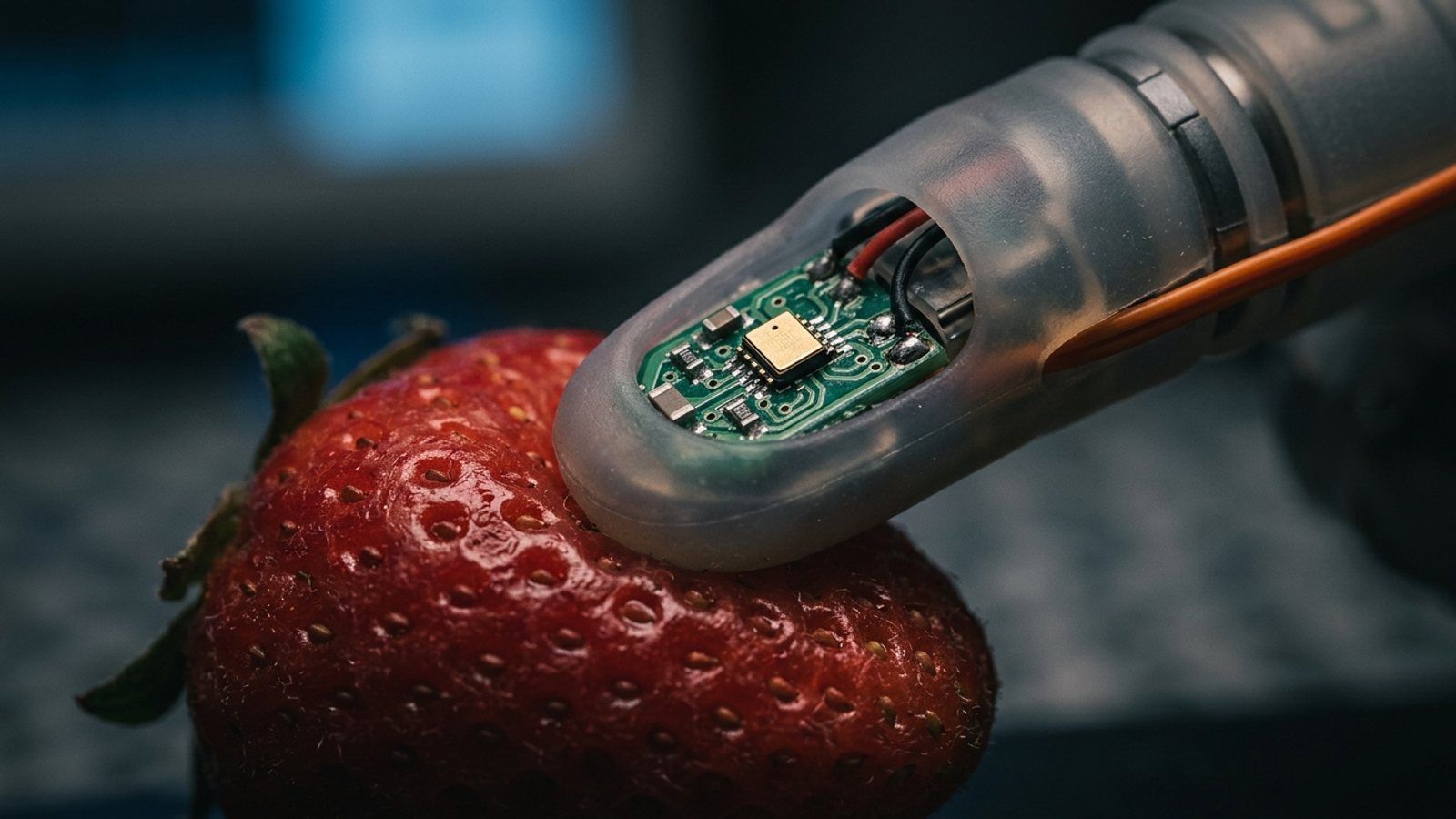
- NYU researchers open-sourced AnySkin, a $5 tactile sensor that gives robots human-like touch.
- The technology uses magnetic field distortions and Hall effect sensors to measure 15-dimensional tactile data.
- AnySkin allows for 'plug-and-play' replacement without recalibrating AI models, solving a major maintenance bottleneck.
- By moving complexity from hardware to software, the cost of robot 'skin' has been decimated for mass deployment.
The NYU AnySkin tactile sensor works by embedding magnetic microparticles in a soft silicone 'skin' over a grid of magnetometers. When the robot touches an object, the magnetic field deforms, and the sensors track that movement in 3D. This allows the robot to feel pressure and grip strength without the $5,000 price tag of traditional optical sensors, while supporting zero-shot generalization across different sensor instances.
I’ve been in these group chats for years, and the one thing that always stops the humanoid hype dead is the bill of materials (BOM). You see a video of a robot doing backflips, but you don’t see the $50,000 price tag for the hands alone.
The industry has been stuck between two bad options: cheap hands that are blind, or expensive hands that break if you look at them wrong.
On September 12, 2024, a team at the NYU Tandon School of Engineering changed the math. They unveiled a tactile sensor called AnySkin that costs about $5 to make. It’s open-source. It’s durable. And it’s the truth for anyone trying to scale a fleet of agents that actually need to touch the real world.
The AnySkin framework addresses the “cost, convenience, and consistency” issues that have historically made touch a second-class citizen in robotics. According to the project documentation, the sensor is fabricated by mixing magnetic microparticles into a soft elastomer, which is then magnetized to create a durable, flexible skin that can be easily swapped out.
How does a $5 sensor give a robot a sense of touch?
The secret isn’t better hardware; it’s smarter physics. Most high-end sensors use cameras to look at how a piece of rubber deforms when it touches something. That’s cool, but it’s expensive and fragile. The NYU team, led by Lerrel Pinto, took a different path. They used magnets.
Per the official research paper, the sensor consists of a soft silicone skin (specifically Smooth-On DragonSkin 10) with magnetic particles embedded inside. Underneath that skin is a grid of Hall effect sensors—the same cheap components that tell your laptop when the lid is closed.
When the robot touches something, the magnet moves. The sensors track that magnetic shift in three dimensions, providing a 15-dimensional tactile reading that an AI model translates into “feeling.”

It’s a classic SRE move: simplify the physical layer and solve the complexity in the software. By using magnetic fields, you get a sensor that doesn’t care about lighting conditions and can take a beating. If you’ve been tracking the Figure 03 vs Tesla Optimus Gen 3 race, you know the hands are the first thing to break.
A $5 fix changes the entire maintenance profile of a robot fleet. Because the sensing electronics are decoupled from the sensing interface, AnySkin simplifies integration, making it as straightforward as putting on a phone case.
Why is tactile sensing so expensive in current robots?
Until now, if you wanted a robot to feel the difference between a grape and a marble, you had to pay the “precision tax.” Companies like GelSight or SynTouch have dominated the space with sensors that are incredible but cost thousands per unit. They rely on complex optical paths or micro-fluidics that are a nightmare to manufacture at scale.
The Robot Report noted that the NYU design specifically targets the “bottleneck of tactile sensing” that has kept humanoids in the lab.
When the “skin” of your robot costs more than the computer driving it, you can’t deploy it in a warehouse where things get messy. To further lower the barrier, the team introduced the AnySense iOS app, which allows researchers to use an iPhone to collect multi-sensory data, integrating AnySkin’s tactile feedback with visual data for more robust model training.
| Sensor Type | Estimated Cost | Main Weakness | Where it Wins |
|---|---|---|---|
| Optical (GelSight) | $2,000 - $5,000 | Bulky, high power draw | Extreme resolution |
| Resistive/Capacitive | $500 - $1,500 | Fragile, prone to noise | Thin profile |
| NYU Magnetic | $5 | Needs local compute | Durability, Cost, Speed |
Which humanoid robots will use the NYU sensor?
This isn’t just for the big labs. Because the design is open-source, we’re seeing a massive trickle-down effect. The best AI agents 2026 guide already highlights how hardware is becoming the new differentiator.
While Tesla is likely to keep their tactile tech in-house, the rest of the market—the ones building the “blue-collar” robots—are looking at this NYU breakthrough as their standard.
Crucially, the researchers demonstrated “cross-instance generalizability,” meaning models trained on one AnySkin instance can generalize to new instances without recalibration. This allows for zero-shot generalization where a model trained on one robot can be deployed on another with a fresh sensor.
I keep saying this: the model is a commodity. Whether you’re running a local LLM or a frontier model, the brain is getting cheaper. The real moat in 2026 is physical interaction.
If you can build a humanoid that can sort laundry or pick strawberries using a $5 sensor, you’ve beaten the $100,000 research bot on ROI every single time.
Is the NYU tactile sensor ready for industrial use?
There’s always a catch. The NYU sensor is great for grip and pressure, but it doesn’t have the “retinal” resolution of a camera-based sensor yet. It’s like the difference between feeling a coin in your pocket and reading the date on that coin with your fingertip.
For 90% of tasks—opening doors, holding tools, or operating a robotaxi—you don’t need to read the date. You just need to not drop the coin.
Lukas Ziegler and other robotics observers have pointed out that the real challenge now is the software stack. You need a fast, low-latency model to turn those magnetic readings into motor commands in real-time.
But with the way we’re seeing edge AI evolve, that’s a problem I’d much rather solve than a $5,000 hardware bill. The AnySkin framework proves that tactile sensing can be consistent, convenient, and cheap. The era of the precious robot is over. The era of the $5 skin is just getting started.

#TheAIMogul
Bottom lineThe NYU AnySkin sensor is the final nail in the coffin for overpriced industrial robotics. If you aren't building robot hands with sub-$10 components in 2026, you’re just building expensive statues.